Web Vision is integrated into the N3uron platform as a visualization layer that connects module configuration, HMI design, runtime operation, and real-time data. Its architecture separates configuration, design, execution, and data acquisition into clearly defined areas.
At a conceptual level, WebUI is used to configure the Web Vision module, Designer is used to create the HMI project, Viewer is used to run the application, and Tags and Historian provide the live and historical data displayed in the interface.
Architecture Overview
The Web Vision architecture is based on the interaction between the N3uron platform services and the Web Vision runtime. Each layer has a specific role in the lifecycle of the HMI application.
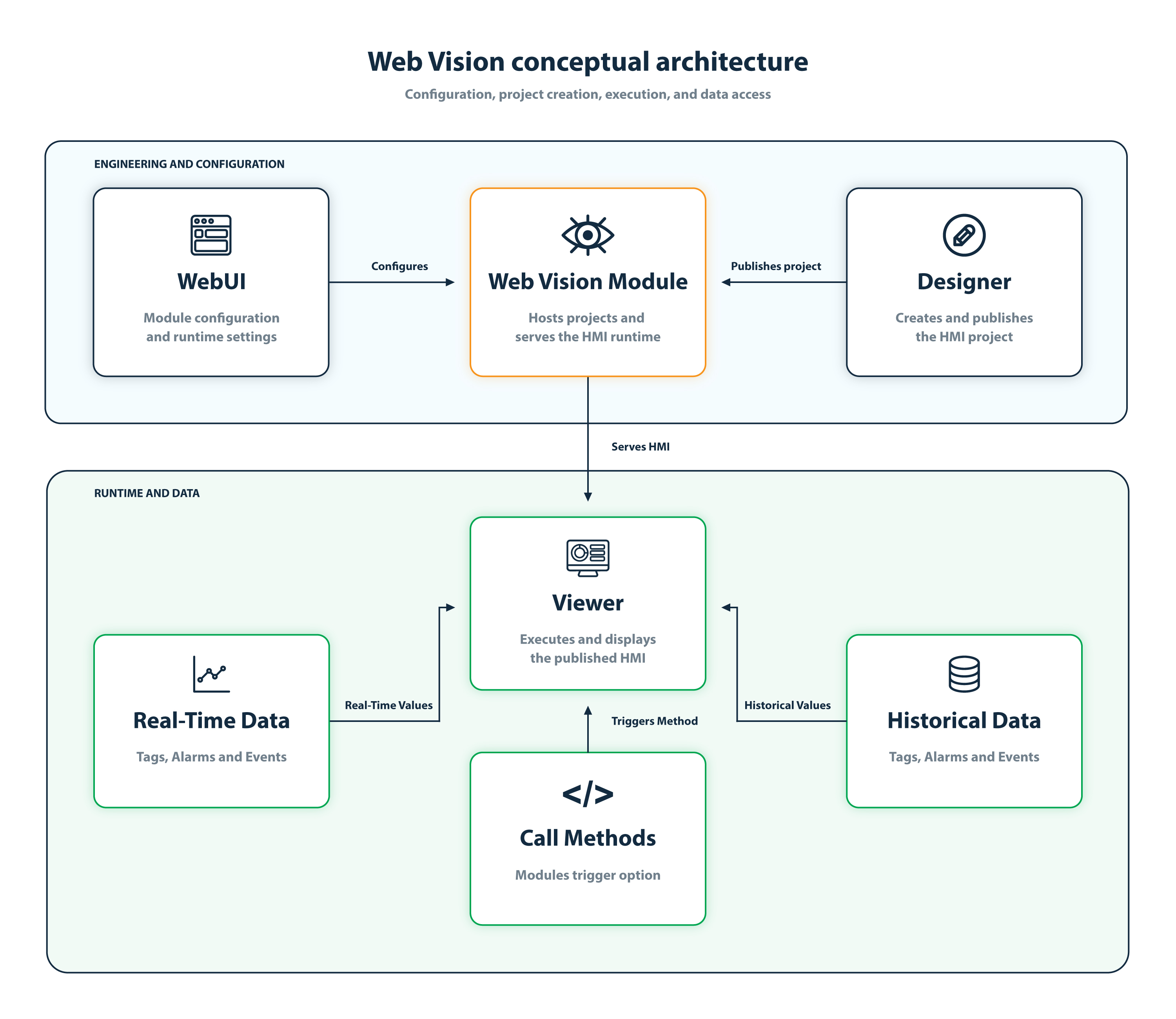
Component | Role in the architecture |
|---|---|
WebUI | Configures the Web Vision module instance, including module settings, access, runtime behavior, and integration with the N3uron platform. |
Designer | Creates and maintains the HMI project. It is used to build pages, templates, visual elements, actions, expressions, functions, and data bindings. |
Viewer | Executes the HMI project at runtime. It displays the operator interface and allows users to interact with live data, controls, dashboards, and navigation. |
Tags | Provide real-time process values, status information, alarms, commands, and other live data used by the HMI. |
Historian | Provides historical data that can be displayed in trends, charts, reports, and time-based visual components. |
Data Flow
Data flows from the N3uron platform into Web Vision through configured Tags and historical sources. The HMI project uses this data to update values, animate elements, show statuses, display trends, and execute configured behavior.
WebUI is used to configure the Web Vision module instance.
Designer is used to create the HMI project and bind visual elements to Tags, Datasets, expressions, and functions.
Viewer loads and executes the configured project at runtime.
Tags provide live values and states to the interface.
Historian provides time-series data for trends, historical charts, and data analysis views.
Design-Time and Runtime Separation
Web Vision separates design activities from runtime execution. This separation allows engineers to build and modify the HMI in Designer while operators access the published interface through Viewer.
This architecture improves maintainability because configuration, project design, and runtime operation each have a clear purpose.
Concept:
WebUI configures the module, Designer creates the HMI, Viewer runs the HMI, and Tags and Historian feed the interface with live and historical data.